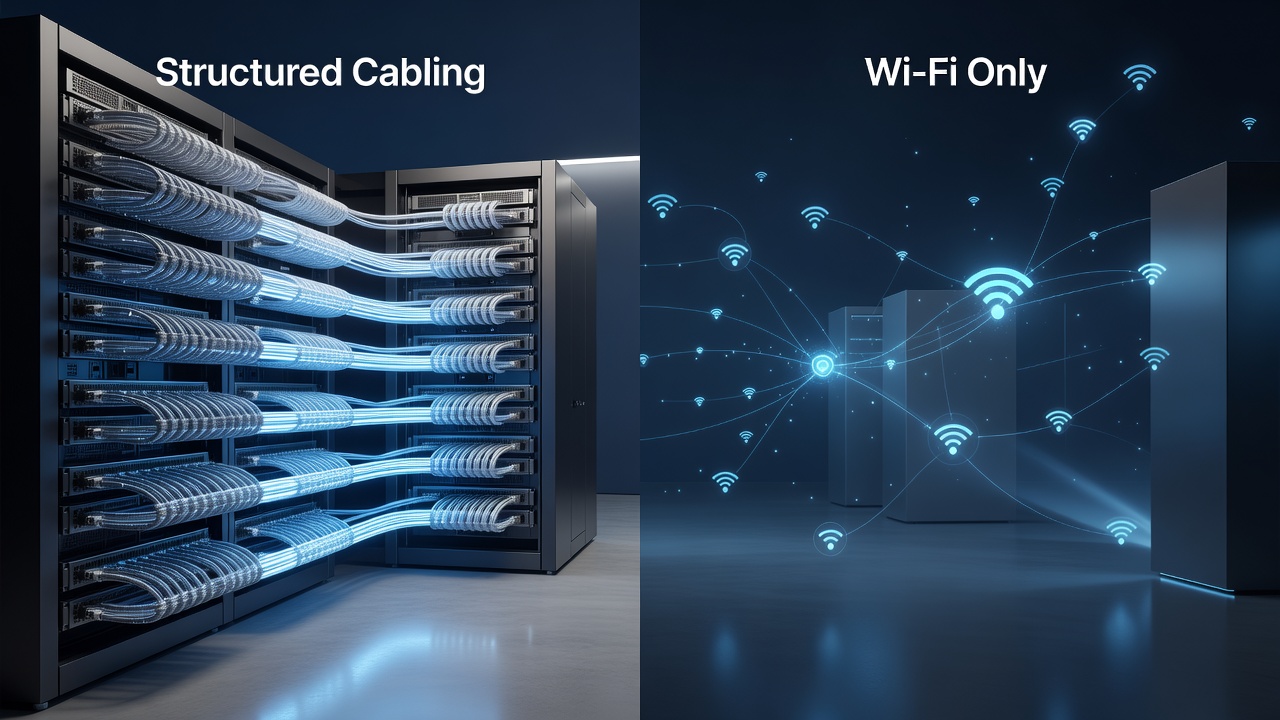
Many business owners in Quincy, IL, assume that modern Wi-Fi is sufficient for any office environment. After all, it is convenient, invisible, and requires no drilling through walls. However, as your team grows and your reliance on cloud applications, video conferencing, and large file transfers increases, a Wi-Fi-only setup often becomes a bottleneck. For small and medium-sized businesses (SMBs) in the Quincy area, the decision between relying solely on wireless connectivity and investing in structured cabling is not just a technical preference; it is a strategic financial decision that impacts daily productivity, security, and scalability.
The Hidden Limitations of Wi-Fi-Only Offices
While Wi-Fi offers flexibility, it suffers from inherent physical limitations that structured cabling does not. Wireless signals degrade over distance and are susceptible to interference from other electronic devices, neighboring buildings, and even physical obstacles like drywall and metal filing cabinets. In a busy office environment, multiple devices competing for the same bandwidth can lead to noticeable latency, dropped calls, and slow file transfers.
For an SMB, these minor inconveniences add up. Imagine a sales team trying to close a deal over a video call that freezes every few minutes, or an accounting department struggling to upload large financial reports at the end of the month. These disruptions cost time, and time is money. Furthermore, Wi-Fi networks are generally more difficult to secure than wired connections. While modern encryption standards are robust, a wired connection is physically harder to intercept, providing an additional layer of security for sensitive business data.
Why Structured Cabling Remains the Backbone of Modern IT
Structured cabling involves the installation of a standardized network infrastructure, typically using Category 6 (Cat6) or Category 6A (Cat6A) Ethernet cables. These cables run from a central patch panel in your server room or network closet to individual workstations, phones, and access points throughout your office. This creates a dedicated, high-speed pathway for data that is not subject to the same interference issues as wireless signals.
The primary advantages of structured cabling for Quincy businesses include:
- Consistent Speed and Reliability: Wired connections provide stable, high-speed internet access that does not fluctuate based on the number of nearby devices or physical obstructions.
- Future-Proofing: Cat6 and Cat6A cables support speeds up to 10 Gbps, ensuring your network can handle future upgrades without needing to re-cable the entire office.
- Enhanced Security: A physical connection is more secure than a wireless one, reducing the risk of unauthorized access to your network.
- Simplified Troubleshooting: Wired networks are easier to diagnose and repair. If a connection fails, you can trace the issue to a specific cable or port, whereas Wi-Fi issues can be more complex to isolate.
The Hybrid Approach: Best of Both Worlds
It is important to note that structured cabling and Wi-Fi are not mutually exclusive. In fact, the most effective network setups for modern offices utilize a hybrid approach. Structured cabling serves as the backbone of your network, providing a stable, high-speed connection to the internet and your local server. Wi-Fi then acts as an extension of this wired infrastructure, allowing mobile devices, laptops, and guests to connect seamlessly.
By using wired connections for desktops, printers, and critical servers, you ensure that your most important devices have the fastest and most reliable access to data. Wi-Fi can then be used for less critical tasks or for devices that require mobility. This approach maximizes the benefits of both technologies, providing the reliability of wired connections with the flexibility of wireless access.
Cost Considerations for Quincy SMBs
One of the most common concerns for business owners is the upfront cost of installing structured cabling. While it is true that cabling requires a higher initial investment than a Wi-Fi-only setup, the long-term costs are often lower. Wi-Fi-only setups may require frequent upgrades to access points and routers to keep up with increasing demand, whereas a well-designed cabling system can last for 10 to 15 years with minimal maintenance.
Additionally, the cost of downtime in a Wi-Fi-only office can be significant. If your wireless network goes down, your entire office may be unable to work. With a hybrid setup, critical functions can continue even if the Wi-Fi is experiencing issues. When evaluating the total cost of ownership, structured cabling often proves to be a more economical choice over the lifespan of your business.
Making the Right Choice for Your Business
The decision to invest in structured cabling depends on your specific business needs, office layout, and growth plans. If your office is small and your team primarily uses laptops for light web browsing, a Wi-Fi-only setup might be sufficient. However, if you have desktop computers, rely on video conferencing, or handle large amounts of data, structured cabling is likely the better investment.
For Quincy SMBs looking to future-proof their IT infrastructure, a hybrid approach is often the ideal solution. By combining the reliability of structured cabling with the flexibility of Wi-Fi, you can create a network that supports your current operations while being ready for future growth.
Conclusion
Structured cabling is not a relic of the past; it is a critical component of a modern, efficient business network. While Wi-Fi offers convenience, it cannot match the speed, reliability, and security of a wired connection. For Quincy small and medium-sized businesses, investing in structured cabling is a strategic move that can improve productivity, enhance security, and reduce long-term IT costs. By adopting a hybrid approach, you can ensure that your office is equipped to handle the demands of today’s digital workplace while remaining flexible enough to adapt to future changes.